If you think the Indian rupee is stable, you’re already behind.
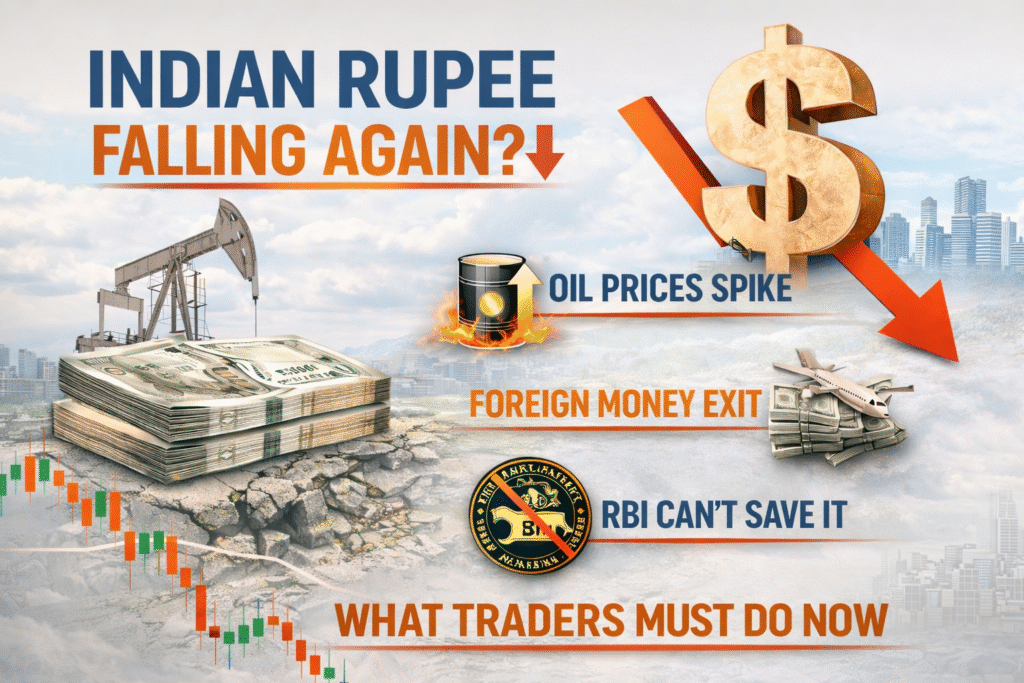
The recent movement in USD INR isn’t random. It’s not noise. And it’s definitely not “normal fluctuation.” The truth is simple: the rupee’s earlier strength was artificial, and now the market is correcting back to reality.
This blog breaks down the real drivers behind rupee weakness, what RBI policy actually means, and how traders should approach the USD INR forecast in 2026.
Why Rupee Is Falling Again (The Real Reason Nobody Talks About)
Let’s cut through the nonsense.
The rupee isn’t weakening because of one factor—it’s a combination of oil prices, capital flows, and policy distortions fading away.
1. Oil Prices Are Rising — And That’s a Direct Hit
India imports nearly 80% of its crude oil.
That means:
- When oil prices go up → India needs more dollars
- More dollar demand → rupee weakens
This is not theory. It’s a mechanical relationship.
Example:
- Oil rises from $75 → $90 → USD demand spikes → USDINR moves up
- Oil drops from $90 → $70 → temporary rupee strength
If you’re not tracking crude oil, you’re trading blind.
2. Foreign Money Is Leaving India (FII Outflows)
This is where most retail traders fail—they ignore capital flows.
When foreign investors pull money out:
- They sell Indian assets
- Convert INR to USD
- Exit the market
Result? Rupee drops. Fast.
Example:
- FII selling ₹10,000 crore → direct pressure on rupee
- Continuous outflows → sustained weakness
No amount of optimism changes this. Money flow decides direction—not opinions.
3. RBI Support Was Temporary — Not Real Strength
Earlier, RBI-related regulatory changes forced banks to sell dollars.
That created:
- Artificial dollar supply
- Temporary rupee strength
But here’s the reality:
Once that support fades, the rupee goes back to fundamentals.
Example:
- Policy-driven rally → short-lived strength
- Policy fades → rupee drops again
If you’re trading based on RBI “support,” you’re playing a losing game.
USD INR Forecast 2026: What Happens Next?
Let’s be clear—there is no single “prediction.” But there are probabilities.
Scenario 1: Oil Continues Rising
- USDINR likely moves higher
- Rupee stays under pressure
Scenario 2: FII Outflows Continue
- Sustained weakness
- Limited recovery even if RBI intervenes
Scenario 3: Global Stability + Oil Drops
- Temporary rupee recovery
- But not long-term strength
RBI Policy Impact on Rupee (Stop Misunderstanding This)
Most people think RBI controls the rupee.
Wrong.
RBI influences—not controls.
Their tools:
- Liquidity management
- Interest rate policy
- Dollar intervention
But they cannot override:
- Global oil prices
- Foreign capital movement
- Geopolitical risk
Example:
- RBI intervenes → short-term stability
- Market forces return → trend continues
So stop assuming RBI will “save” the rupee.
Crude Oil Impact on Indian Rupee (This Is Your Primary Indicator)
If you only track one thing—track oil.
Here’s the relationship:
- Oil ↑ → Rupee ↓
- Oil ↓ → Rupee ↑
But don’t oversimplify:
- Sudden spikes → sharp INR weakness
- Gradual decline → slow INR recovery
Example:
- Middle East tension → oil spike → immediate rupee fall
- Peace talks → oil drop → rupee stabilizes
This is the most reliable macro signal for USD INR trading.
Indian Rupee Prediction This Week (Short-Term View)
Short-term movements depend on:
- Oil price fluctuations
- FII activity
- Global dollar strength
What traders should watch daily:
- Brent crude price
- FII/DII data
- US dollar index (DXY)
Example:
- Oil jumps + FII selling → bearish INR
- Oil drops + FII buying → bullish INR
No indicators, no fancy setups—just follow the drivers.
USD INR Trading Strategy (What Actually Works)
Let’s get practical.
Most traders lose because they:
- Overuse indicators
- Ignore macro factors
- Trade blindly on patterns
Here’s what actually works:
Strategy 1: Oil-Based Directional Bias
- If oil is trending up → look for USDINR buy setups
- If oil is falling → look for sell opportunities
Example:
- Oil breakout → buy USDINR on dips
- Oil crash → sell rallies
Strategy 2: Capital Flow Confirmation
Don’t trade unless flows support your bias.
- FII selling → confirm bearish INR
- FII buying → confirm bullish INR
Example:
- Oil up + FII outflow → strong buy signal
- Oil up but FII inflow → avoid trade
Strategy 3: Ignore Noise, Trade Structure
News is noise. Structure is truth.
- Identify key support/resistance in USDINR
- Align with macro direction
Example:
- Macro bearish INR + breakout → enter
- Macro bullish INR + breakdown → enter
Global Currency Market Trends (Why INR Is Vulnerable)
The Indian rupee is part of a bigger system—emerging market currencies.
When global risk increases:
- Investors move to USD (safe haven)
- Emerging currencies weaken
Example:
- US interest rates rise → dollar strengthens → INR falls
- Global uncertainty → capital exits EM → INR weakens
So don’t analyze INR in isolation. It’s part of a global chain reaction.
The Hard Truth Most Traders Ignore
Let’s be blunt:
- The rupee is not strong—it’s managed
- Its movements are predictable if you track the right variables
- Most traders lose because they focus on the wrong things
If you’re:
- Watching indicators but ignoring oil → you’re wrong
- Trading news headlines → you’re late
- Ignoring capital flows → you’re blind
Where Most Traders Fail (And How to Fix It)
Mistake 1: Indicator Addiction
- Example: RSI, MACD overload → confusion
- Fix: Focus on macro drivers
Mistake 2: Ignoring Global Factors
- Example: Only tracking Indian news
- Fix: Watch oil + US dollar
Mistake 3: Emotional Trading
- Example: Buying because “it looks strong”
- Fix: Trade data, not feelings
How Geopolitics Is Quietly Controlling the Indian Rupee
If you’re ignoring geopolitics, you’re missing half the game.
The Indian rupee doesn’t move in isolation. It reacts instantly to global tensions—especially those connected to oil supply chains.
Key Trigger: Middle East Instability
Any disruption in major oil-producing regions directly impacts India.
Example:
- Conflict escalation → oil supply fear → crude spikes → rupee weakens
- Diplomatic resolution → oil stabilizes → rupee gets relief
This isn’t optional knowledge. It’s essential.
US–Iran Dynamics (Hidden Driver Most Traders Ignore)
When negotiations fail or tensions rise:
- Oil supply risk increases
- Global markets panic
- Dollar strengthens
Example:
- US–Iran talks collapse → oil jumps → INR drops sharply
- Talks resume → oil cools → INR stabilizes
You don’t need to be a geopolitical expert. Just track major developments and connect them to oil.
Interest Rates & Dollar Strength: The Silent Pressure
The US dollar index (DXY) plays a bigger role than most Indian traders realize.
When the US Federal Reserve keeps rates high:
- Dollar becomes attractive
- Global capital flows into USD
- Emerging currencies like INR weaken
Simple Relationship:
- US rates ↑ → USD ↑ → INR ↓
- US rates ↓ → USD ↓ → INR ↑
Example:
- Fed signals no rate cuts → dollar strengthens → rupee falls
- Fed hints at easing → dollar weakens → rupee recovers
Ignoring this is a rookie mistake.
Intraday vs Positional Trading in USD INR (Stop Mixing Them Up)
Most traders lose because they mix strategies.
Intraday Trading (Short-Term Noise)
- Focus: volatility, quick moves
- Drivers: news spikes, liquidity
Example:
- Sudden oil spike → quick USDINR jump → intraday buy
- RBI intervention rumor → sharp drop → intraday sell
Positional Trading (Real Money Moves)
- Focus: macro trends
- Drivers: oil, FII flows, global risk
Example:
- Sustained oil rally → hold USDINR long
- Continuous FII inflows → hold short bias
If you use intraday logic for positional trades—you’ll get destroyed.
What Smart Traders Are Doing Right Now
Forget retail noise. Focus on what informed traders are doing:
- Watching crude oil like a hawk
- Tracking FII/DII data daily
- Aligning with global dollar strength
- Avoiding overtrading during uncertainty
Example:
- Oil breakout + FII selling → building USDINR long positions
- Oil stable + no flows → staying out
Sometimes the best trade is no trade.
The Next Big Opportunity in USD INR
Here’s what you should be waiting for:
Setup 1: Oil Breakout + Weak INR
- Strong continuation move
- High-probability trade
Setup 2: Oil Crash + FII Inflows
- Reversal opportunity
- Short USDINR setups
These are not daily setups. But when they come, they’re powerful.
About 3D Trading Academy
If you’re serious about trading, random YouTube strategies won’t cut it.
3D Trading Academy focuses on:
- Market structure understanding
- Real macro-driven trading (not indicator hype)
- Practical strategies for forex and currency trading
Unlike typical courses that overload you with theory, the approach here is:
- Simple
- Data-driven
- Execution-focused
If you actually want to understand how markets move—not just react to them—this kind of structured learning matters.