A Practical Guide for Beginners | 3D Trading Academy
Introduction
Every year, thousands of people step into the stock market with dreams of achieving financial freedom and building long-term wealth. With the rise of online trading Every year, thousands of people step into the stock market with dreams of achieving platforms and easy access to financial information, learning to trade has become more accessible than ever. However, while many beginners enter the market with excitement and high expectations, a significant number struggle because they make the same avoidable mistakes.
The truth is that successful trading is not about luck or guessing market movements. It is about having the right knowledge, following a disciplined approach, managing risk effectively, and continuously learning from experience. Professional traders understand that protecting their capital is just as important as making profits.Beginners, however, often let emotions, impatience, and misinformation guide their decisions.
If you are just starting your trading journey, understanding these common mistakes can save you from unnecessary losses and help you build a stronger foundation. In this guide, we will explore the 10 most common trading mistakes beginners make and how to avoid them, helping you become a more confident and disciplined trader.
1. Trading Without a Plan
One of the biggest mistakes new traders make is entering the market without a proper trading plan. Many people take trades based on social media tips, market rumors, or emotions without having a clear reason for entering or exiting a position.
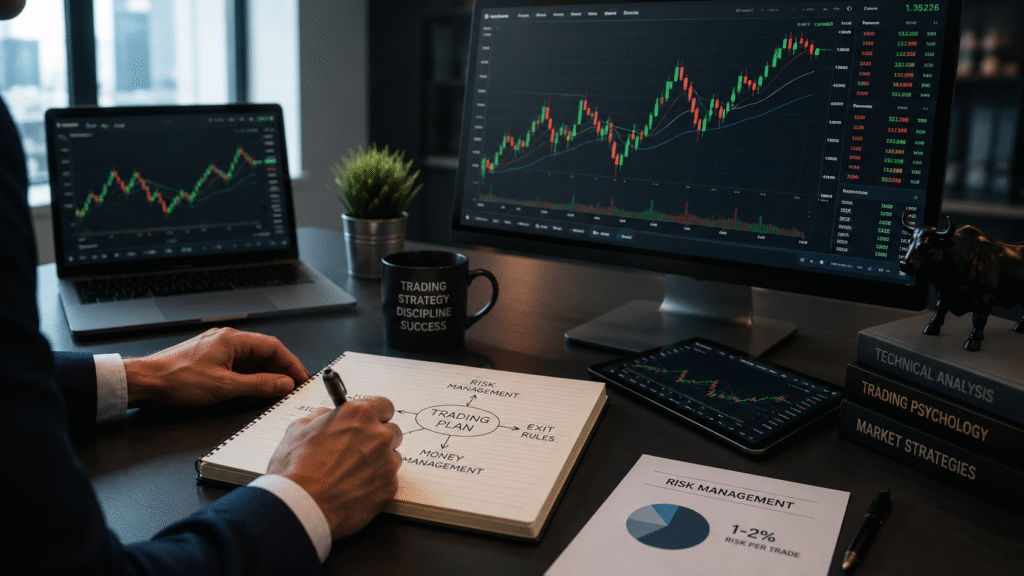
A trading plan acts as your roadmap. It helps you define your strategy, entry and exit points, risk tolerance, and profit targets. Without a plan, traders often react emotionally to market fluctuations, leading to inconsistent results.
Why it happens:
- Following friends or social media influencers.
- Entering trades based on excitement or fear.
- Lack of understanding of trading strategies.
How to avoid it:
- Create a written trading plan before placing any trade.
- Define your entry, exit, and stop-loss rules.
- Set realistic profit targets and acceptable risk levels.
- Review your strategy regularly and improve it over time.
A well-defined trading plan helps you stay disciplined and reduces impulsive decisions.
2. Overtrading
Many beginners think that more trades mean more opportunities to make money. In reality, overtrading often results in poor decisions, higher transaction costs, and unnecessary losses.
Overtrading is usually caused by the fear of missing out (FOMO) or the desire to make quick profits. Successful traders know that waiting patiently for the right opportunity is far more effective than trading every market movement.
Why it happens:
- Fear of missing profitable opportunities.
- Trying to recover previous losses quickly.
- Trading out of boredom or excitement.
How to avoid it:
- Focus only on high-quality trade setups.
- Set a daily or weekly trade limit.
- Follow your trading plan instead of your emotions.
- Remember that patience is a key trading skill.
In trading, quality always matters more than quantity.
3. Ignoring Stop-Loss Orders
A stop-loss is one of the simplest yet most powerful tools in trading. Unfortunately, many beginners avoid using stop-loss orders because they hope the market will eventually move back in their favor.
The reality is that every trader experiences losses. The difference between successful traders and unsuccessful ones is that successful traders know how to control those losses.
Why it happens:
- Fear of accepting a losing trade.
- Hope that the market will reverse.
- Lack of knowledge about risk management.
How to avoid it:
- Decide your stop-loss level before entering a trade.
- Never remove or widen your stop-loss out of fear.
- Accept small losses as part of the trading process.
- Prioritize capital protection over chasing profits.
Remember, a small controlled loss is always better than a large unexpected one.
4. Letting Emotions Control Trading Decisions
Trading is not only about technical analysis and charts; it is also about psychology. Emotions such as fear, greed, frustration, and overconfidence can easily influence your decisions and lead to costly mistakes.
For example, after a few successful trades, some traders become overconfident and increase their position size without proper analysis. On the other hand, fear after a losing trade may stop them from taking the next valid opportunity.
Common emotions that affect traders:
- Fear
- Greed
- Frustration
- Overconfidence
How to avoid it:
- Follow your trading plan consistently.
- Keep a trading journal to review your decisions.
- Focus on the process rather than short-term results.
- Take breaks when you feel emotionally overwhelmed.
Discipline and emotional control are essential qualities for long-term trading success.
5. Risking Too Much on One Trade
Another common beginner mistake is risking a large percentage of the trading account on a single trade. Even the best trading setups can fail, and no trade is guaranteed to succeed.
Risking too much creates emotional pressure and can significantly damage your account if the trade goes against you.
Why it is dangerous:
- One bad trade can erase weeks or months of gains.
- Large losses increase stress and fear.
- Recovering from a major drawdown becomes difficult.
How to avoid it:
- Risk only 1–2% of your capital on any single trade.
- Use proper position sizing techniques.
- Focus on consistency instead of quick profits.
- Think about long-term account growth.
Professional traders survive because they protect their capital.
6. Chasing Market Tips
Social media groups, messaging apps, and online forums are filled with stock tips and trading recommendations. Many beginners blindly follow these tips without understanding the logic behind them.
The problem is that every trader has different goals, strategies, and risk tolerance. What works for someone else may not work for you.
Problems with chasing tips:
- Lack of proper technical analysis.
- Unverified or misleading information.
- Different financial goals and risk tolerance.
How to avoid it:
- Learn the basics of technical and fundamental analysis.
- Build your own trading strategy.
- Verify information before acting on it.
- Develop independent decision-making skills.
The best traders do not depend on tips—they depend on knowledge and preparation.
7. Ignoring Risk Management
Many traders spend hours learning chart patterns and indicators but overlook the importance of risk management. In reality, risk management is what separates long-term successful traders from those who quickly lose their capital.
Even a good strategy can fail without proper risk control.
Risk management includes:
- Setting stop-loss levels.
- Using proper position sizing.
- Maintaining a healthy risk-to-reward ratio.
- Avoiding excessive leverage.
Why it matters:
Risk management protects your trading capital and helps you stay in the market long enough to benefit from future opportunities. The first goal of every trader should be survival, and the second goal should be growth.
8. Trying to Recover Losses Quickly (Revenge Trading)
After experiencing a loss, many beginners immediately enter another trade hoping to recover their money. This behavior, commonly known as revenge trading, often leads to even bigger losses because decisions are driven by frustration instead of analysis.
Losses are a natural part of trading. Even experienced traders face losing streaks, but they do not let emotions dictate their actions.
How to avoid it:
- Accept losses as part of the trading journey.
- Step away from the market after a significant loss.
- Review your mistakes objectively.
- Never increase your position size to recover losses quickly.
Never increase your position size to recover losses quickly.
9. Lack of Continuous Learning
The financial markets are constantly evolving due to changes in economic conditions, technology, and investor behavior. Traders who stop learning often struggle to adapt to these changes.
Successful traders understand that education is a lifelong process. The more knowledge you gain, the better prepared you are to make informed decisions.
Keep learning through:
- Trading and investment books.
- Educational webinars and workshops.
- Daily market analysis.
- Reviewing your trading journal.
- Learning from both wins and losses.
The most successful traders are always students of the market.
10. Expecting Quick Riches
Perhaps the biggest misconception about trading is that it is a shortcut to becoming rich overnight. Social media often highlights huge profits but rarely shows the years of discipline, practice, and learning behind those results.
Trading is not a lottery ticket—it is a professional skill that takes time to develop. Setting unrealistic expectations often causes beginners to take unnecessary risks and abandon their plans.
Instead of chasing quick profits, focus on:
- Building consistency.
- Developing trading discipline.
- Following effective risk management practices.
- Improving your knowledge and strategy.
- Achieving long-term, sustainable growth.
The traders who succeed are not necessarily the smartest—they are often the most patient and disciplined.
Final Thoughts
The goal of trading is not to win every single trade. Even professional traders experience losses. The true objective is to manage risk, stay disciplined, and continuously improve your decision-making process.
By understanding and avoiding these common mistakes, you can build a stronger foundation for long-term success in the financial markets. Creating a solid trading plan, controlling emotions, using stop-loss orders, practicing proper risk management, and committing to continuous learning will help you become a more confident and responsible trader.
Every successful trader started as a beginner and learned valuable lessons through experience. The difference is that they used those lessons to improve instead of giving up. Trading is a journey of growth, patience, and discipline, and every step you take toward improving your skills brings you closer to your financial goals.
Build Your Trading Future with 3D Trading Academy
Avoiding common trading mistakes is the first step toward becoming a confident and disciplined trader. But true success comes from learning the right strategies, developing the right mindset, and receiving guidance from experienced mentors.
At 3D Trading Academy, you’re not just learning how to trade—you’re building a smarter future. Our mission is to empower aspiring traders with practical market knowledge, proven trading techniques, and disciplined risk management strategies that lead to long-term success.
Whether you’re completely new to the stock market or looking to sharpen your existing skills, 3D Trading Academy provides the education and support you need to trade with confidence and clarity.
Get in Touch with 3D Trading Academy
Ready to start your trading journey? Connect with us today and take the first step toward financial freedom.
📞Call Us
+91 7675957697
+91 9381224061
📧 Email Us
3dtradingacademy@gmail.com
Learn Smart. Trade Smart. Grow with 3D Trading Academy.